☰
The Dulverton Circular Walk — Exmoor’s Longest Classic, Ancient Clapper Bridge & River Barle
A grazing herd of Exmoor ponies, the longest clapper bridge in Britain, a remote moorland church and a homeward walk along the wooded River Barle — the great full-day classic of southern Exmoor. Stay in a handpicked cottage right on the route.
Browse Cottages →
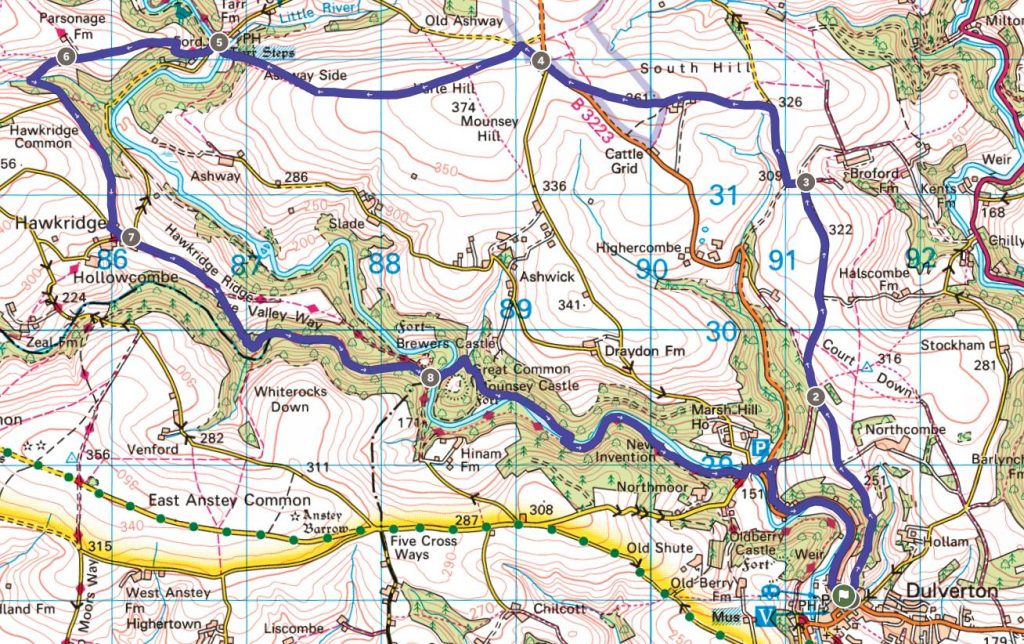
The Dulverton Circular Walk is the grand full-day circuit of southern Exmoor — a 20.3 km (12½-mile) loop that climbs out of the riverside town of Dulverton onto the high ground above Broford and Varle Hill, drops to the ancient clapper bridge at Tarr Steps, then follows the Two Moors Way to the remote village of Hawkridge before returning home down the steep, wooded valley of the River Barle.
One of the twelve walks in the Exmoor Classics series, the route is the longest of them all. It starts from Dulverton’s main car park, heads uphill past Highercombe Farm to Mounsey Hill Gate, then crosses open moorland where Exmoor ponies graze on Varle Hill. From Tarr Steps it climbs to Parsonage Farm and Hawkridge, before tracing Hawkridge Ridge and dropping through woodland to Castle Bridge and Marsh Bridge for the final riverside miles back into town.
At 20.3 km (about twelve and a half miles) with roughly 500 metres of ascent, this is a proper day on the moor — allow five to six hours of walking time. In return, you get a Grade I-listed medieval bridge wrapped in legend, a National Nature Reserve, free-roaming Exmoor ponies and one of the loveliest river valleys in the National Park, all on a single well-waymarked loop.
The Dulverton Circular Walk in This Guide
1. Quick Facts About the Dulverton Circular Walk
- Distance: 20.3 km (about twelve and a half miles)
- Total ascent: Around 500 metres (1,640 feet)
- Duration: About five to six hours of walking time — a full day out
- Difficulty: Challenging — not for the distance alone, but for the steady moorland climbs and remote middle section
- Start / end: Exmoor House Pay & Display Car Park, Dulverton
- Postcode: TA22 9HL · beside the Exmoor National Park Centre off Fore Street
- Terrain: Town lanes, restricted byway, open moorland, field paths, a clapper-bridge river crossing and steep riverside woodland
- Dog-friendly: Yes — keep dogs on a lead near livestock, Exmoor ponies and ground-nesting birds
- Toilets: In Dulverton at the start; also near Tarr Steps roughly halfway round
- Refreshments: Pubs, cafes and shops in Dulverton (start and finish) and the Tarr Farm Inn beside Tarr Steps (halfway)
2. Dulverton Circular Walk Route Directions
Eight waypoints take you round the full Dulverton & Tarr Steps Circular Walk. First, you climb out of Dulverton onto the Broford byway and over the high ground to Mounsey Hill Gate. Then you cross Varle Hill to Tarr Steps, follow the Two Moors Way up to Hawkridge, and finally trace Hawkridge Ridge before dropping to the River Barle for the woodland miles home.
Stage 1 — Dulverton to the Broford Byway
First, from the car park make your way into the town centre, passing the Exmoor National Park Centre and walking up to Bank Square at the top of Fore Street. Bear right around the church, up the steps to its side and left into the lane. Then follow the purple Restricted Byway signposted Broford, continuing uphill along the main track as it climbs out of town.
Stage 2 — Broford to Leigh Lane
A mile from Dulverton, pass the track to Marsh Bridge on your left and go through the gateway ahead. Stay on the waymarked route across a field, forking right amongst the gorse, signposted Broford 1 / Winsford 2½. Finally, go through a gate and along the lane to a junction with a tarmac road known as Leigh Lane.
Stage 3 — Leigh Lane to Mounsey Hill Gate
Turn left along the road, signposted Winsford 2½. After approximately half a mile, turn left into a field via a gate, signposted Public Bridleway Mounsey Hill Gate 1¼. Keep to the left of the field, past Highercombe Farm, towards a gate onto open moorland. Pass through and follow the bridleway, signposted Mounsey Hill Gate 1, as it takes you towards and alongside the B3223 to a cattle grid at Mounsey Hill Gate.
Stage 4 — Mounsey Hill Gate to Tarr Steps
Go through the gate by the cattle grid, cross over the road and follow the bridleway signposted Public Bridleway Tarr Steps 2. On reaching a small parking area, bear left along Varle Hill — where you may well meet a herd of Exmoor ponies grazing — signposted Public Footpath Tarr Steps 1½. The path gradually takes you downhill past a series of signposts towards woodland. At a junction of paths, follow the bridleway signposted Tarr Steps ¼, then cross a small bridge to arrive at Tarr Steps.
Stage 5 — Tarr Steps to Parsonage Farm (Two Moors Way)
Cross the Tarr Steps clapper bridge and then bear left briefly along the road before bearing right up a driveway, signposted Public Bridleway Parsonage Farm ¾ MW. As you continue uphill, follow the Two Moors Way (MW) signposts through fields to Parsonage Farm.
Stage 6 — Parsonage Farm to Hawkridge
Pass through the farm buildings and down the farm driveway until you meet a road. Cross over and pass through a gate, signposted Public Footpath Hawkridge ¼. Then continue through several fields to the village of Hawkridge.
Stage 7 — Hawkridge to Castle Bridge
On reaching a road, turn left and, leaving the Two Moors Way, turn left again, passing St Giles’ Church on your right. Continue ahead on a stone-based track towards Dulverton. The way ahead takes you through fields along Hawkridge Ridge and then downhill through woodland to Castle Bridge.
Stage 8 — Castle Bridge to Dulverton
Cross the stone bridge and, with the river on your left, follow the path through woodland to Marsh Bridge. On reaching Marsh Bridge Cottage, turn right along the road before re-joining the footpath to Dulverton. After passing between some buildings, the path takes you through Burridge Wood and back into Dulverton. Finally, cross Barle Bridge and return to the car park to complete the Dulverton & Tarr Steps Circular Walk.
3. Highlights Along the Dulverton Circular Walk
Dulverton
Often called the “gateway to Exmoor,”
Dulverton is a characterful little town wrapped around the River Barle. It’s home to the headquarters of the
Exmoor National Park Authority at Exmoor House, along with independent shops, galleries, cafes and pubs — the perfect place to load up before the walk and to celebrate afterwards. For more, see our
Dulverton visitor’s guide.
Tarr Steps
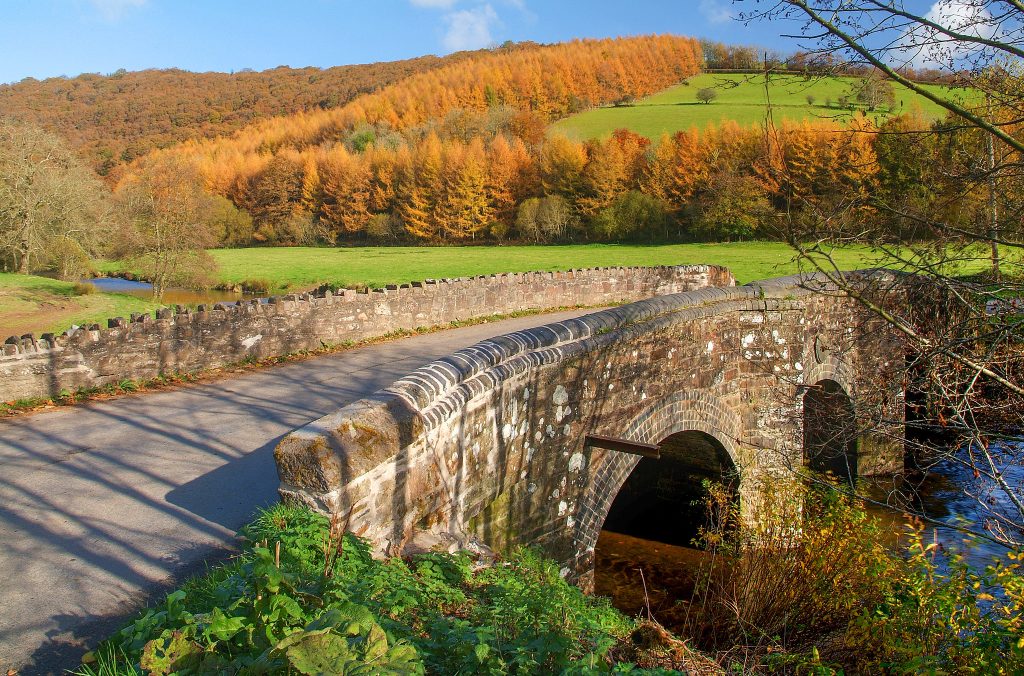
The undisputed star of the walk, Tarr Steps is the longest clapper bridge in Britain — a Grade I-listed crossing of the River Barle made of seventeen spans of huge flat stone slabs, each weighing between one and two tons, laid end to end across the water for roughly 55 metres (180 feet). It sits within the Tarr Steps Woodland National Nature Reserve, a magical tangle of ancient sessile oak draped in mosses, lichens and ferns.
The River Barle & Burridge Wood
The whole final third of the walk follows the
River Barle downstream, from Castle Bridge through to Marsh Bridge and the oak woodland of
Burridge Wood on the edge of Dulverton. It’s a classic Exmoor river valley — dippers and grey wagtails on the water, salmon and trout below, and a cool, green canopy overhead. The Barle is also one of Exmoor’s favourite wild-swimming rivers; see our guide to
Exmoor’s top wild swimming spots.
Exmoor Ponies on Varle Hill
As you cross the open moorland of Varle Hill on the way to Tarr Steps, keep an eye out for free-roaming Exmoor ponies. One of Britain’s oldest and rarest native breeds, these hardy little ponies have grazed the moor for thousands of years and are perfectly adapted to its weather. Please give them plenty of space — admire from a distance and never feed them.
Image credit: Neville Stanikk
Hawkridge & St Giles’ Church
High on its ridge between the Barle and Danesbrook valleys, Hawkridge is one of the most remote and unspoilt villages on Exmoor — a scatter of farms and cottages around the small medieval church of St Giles. The walk passes right through it, and the views from Hawkridge Ridge on the homeward leg are among the finest of the day.
The Two Moors Way
Between Tarr Steps and Hawkridge, the route joins the Two Moors Way — the celebrated long-distance path that runs for around 102 miles across the heart of the South West, linking Exmoor with Dartmoor. The Tarr Steps–to–Hawkridge stretch is one of its prettiest sections, climbing steadily through fields with the moor opening up behind you.
Stay near Tarr Steps & Hawkridge

Kiri Cottage, Hawkridge
Sleeps 6 · In Hawkridge, on the route
Book

Smiddy Cottage, Hawkridge
Sleeps 4 · In Hawkridge, on the route
Book

One Lower Spire Cottage, Liscombe
Sleeps 5 · Near Tarr Steps
Book
4. History & Heritage on the Dulverton Circular Walk
The Tarr Steps Clapper Bridge
Clapper bridges are simple dry-stone crossings — flat stone slabs resting on stone piers, with no mortar to bind them. Of the few dozen that survive in Britain, Tarr Steps is easily the longest, with its seventeen spans stretching some 55 metres across the Barle. The earliest written reference dates from the Tudor period, and while most experts now agree the bridge is medieval, local tradition holds that it is far older — with some claiming origins as much as 3,000 years ago. Because it has no mortar, the bridge is regularly swept away by floods on the Barle and painstakingly rebuilt; the stones are numbered so they can be put back in the right order, most recently after the major floods of 2012.
The Devil’s Bridge
No Exmoor landmark has a better legend. The story goes that the Devil built Tarr Steps for a wager and declared he would sunbathe on the slabs, swearing to destroy anyone who dared to cross. To test him, the villagers first sent a cat over — and it vanished on the spot. The local parson then strode out to confront the Devil in the middle of the bridge. After a fearsome exchange of insults, the Devil backed down and grudgingly agreed to let people cross — except, so the tale goes, when he wishes to sunbathe himself.
Lorna Doone Country
This corner of Exmoor is the setting for R. D. Blackmore’s 1869 romance Lorna Doone. In the novel, the wise woman Mother Melldrum keeps a summer cave “far inland near Hawkridge, and close above Tarr-steps, a wonderful crossing of the Barle river, made (as everybody knows) by Satan for a wager” — weaving the bridge’s Devil legend straight into the story. Walking the moor between Hawkridge and Tarr Steps, it’s easy to see why Blackmore chose this remote, romantic landscape.
Dulverton & the Exmoor National Park
Dulverton has been a market town on the southern edge of the moor for centuries, and today it is the administrative heart of the National Park: the Exmoor National Park Authority is based at Exmoor House, a former workhouse beside the river, and runs a National Park Centre in the town. The walk begins and ends within a few steps of both.
The Exmoor Classics Series
The Dulverton & Tarr Steps Circular Walk is one of the
Exmoor Classics — the National Park’s series of twelve longer waymarked walks — and at 20.3 km it is the longest in the collection. Other routes in the series include Dunster & Bat’s Castle, Combe Martin & Great Hangman, Countisbury, Bossington Hill and the Valley of Rocks. Printed leaflets are available from the National Park Centres at Dulverton, Dunster and Lynmouth, or via the
Exmoor National Park website. For more, see our full collection of
Exmoor circular walks.
Stay in Dulverton, Winsford & the Barle Valley

Stockham Farm, Dulverton
Sleeps 4 · On the edge of Dulverton
Book
Ball Cottage, Winsford
Sleeps 5 · In Winsford village
Book

Merrijig, Dulverton
Sleeps 6 · In Dulverton town
Book
5. Practical Information for the Dulverton Circular Walk
Getting There & Parking
The walk starts and ends at the Exmoor House Pay & Display Car Park in Dulverton (postcode TA22 9HL), beside the Exmoor National Park Centre just off Fore Street. There are public toilets in the town, and Dulverton is well served by the A396 from Tiverton and the B3222/B3223 from the M5. Note that there is also a small car park at Tarr Steps roughly halfway round, should you wish to walk a shorter there-and-back version instead.
Refreshments on the Route
Unlike many moorland walks, this one has a welcome halfway stop: the
Tarr Farm Inn sits right beside Tarr Steps and serves food and drink to walkers. Otherwise, all the options are in
Dulverton at the start and finish, where you’ll find pubs, tearooms, a deli and independent cafes. Importantly, the long middle section over the moor has no facilities at all, so carry plenty of water and snacks. For ideas, see our
guide to the best pubs on Exmoor.
Dogs on the Dulverton & Tarr Steps Walk
Dogs are welcome, but please keep them under close control throughout. In particular, you’ll cross open moorland grazed by sheep and free-roaming Exmoor ponies on Varle Hill, and pass through working farms at Highercombe, Parsonage and around Hawkridge. If you feel threatened by cattle, drop the lead and move away calmly, especially when they are with calves. Additionally, the woodland along the Barle is home to ground-nesting birds in spring. Finally, bag any waste and carry it with you until you reach a bin.
What to Wear
- Footwear: Walking boots — the moorland and field sections are uneven, and the riverside paths can be muddy and root-strewn
- Layers: The high ground around Varle Hill and Hawkridge Ridge is exposed; bring a windproof and warm layer even in summer
- Waterproofs: Weather on Exmoor can change quickly, and this is a long day out
- Map: OS Explorer OL9 (Exmoor) or the Exmoor Classics Dulverton & Tarr Steps leaflet, available from National Park Centres
- Extras: Plenty of water, food, and a charged phone — mobile signal is patchy on the moor
Waymarking
First, the outward leg follows the purple Restricted Byway fingerposts towards Broford, then bridleway signs to Mounsey Hill Gate and Tarr Steps. Next, the central section follows the Two Moors Way (MW) from Tarr Steps to Hawkridge. Finally, footpath signs lead you along Hawkridge Ridge and down to the River Barle for the return to Dulverton. Importantly, all rights of way on Exmoor use handmade fingerposts — footpaths are marked with a yellow tip, bridleways with a blue tip.
Safety Note
This is the longest of the Exmoor Classics — 20.3 km with around 500 metres of ascent — and much of the middle section is remote, with no facilities and patchy phone signal. Therefore, start early, carry food, water and a map, and tell someone your plans. Crucially, do not attempt to cross Tarr Steps when the River Barle is in spate: the slabs flood and become dangerously slippery after heavy rain, and people have been swept off them. If the river is high, turn back rather than risk the crossing.
6. Where to Stay near the Dulverton Circular Walk
The route threads through some of southern Exmoor’s loveliest country — Dulverton itself, the hamlet of Liscombe by Tarr Steps, the remote village of Hawkridge, and the Barle and Exe valleys around Winsford and Brushford. Below are three more handpicked cottages on or near the route, from a cosy bolt-hole for two to a six-sleeper for the whole family. You might also enjoy our
complete guide to Tarr Steps or our
Exmoor map and area guide for the bigger picture.
More Cottages near the Dulverton Circular Walk
The Piggery, Dulverton
Sleeps 6 · Stockham Farm, Dulverton
Book

Byre Cottage, Dulverton
Sleeps 2 · Draydon, near Dulverton
Book

Meadow View, Brushford
Sleeps 6 · Brushford, near Dulverton
Book
Frequently Asked Questions
How long does the Dulverton Circular Walk take?
Allow five to six hours of walking time for the full 20.3 km (12½-mile) loop, plus extra for lunch at the Tarr Farm Inn and stops along the river. Most walkers treat it as a full day out, finishing back in Dulverton in the late afternoon.
How difficult is the Dulverton Circular Walk?
It’s the longest and one of the more challenging routes in the Exmoor Classics series. There’s around 500 metres of ascent, spread over steady moorland climbs rather than anything steep, but the distance and the remote middle section mean a reasonable level of fitness and good navigation are needed.
Where do I park for the Dulverton & Tarr Steps Circular Walk?
Park at the Exmoor House Pay & Display car park in Dulverton (postcode TA22 9HL), beside the Exmoor National Park Centre. The walk heads up through the town centre to Bank Square at the top of Fore Street to begin.
What is Tarr Steps?
Tarr Steps is the longest clapper bridge in Britain — a Grade I-listed crossing of the River Barle made of seventeen huge stone slabs, each weighing one to two tons. It is at least medieval, possibly far older, and famously said to have been built by the Devil for a wager.
Can I walk a shorter version?
Yes. If 12½ miles is too much, drive to the small car park at Tarr Steps and do a shorter there-and-back or mini-loop along the River Barle instead — you’ll still see the famous clapper bridge and the nature reserve without the full moorland circuit.
Is the Dulverton & Tarr Steps Walk suitable for dogs?
Yes, but keep dogs on a lead. The route crosses open moorland with sheep and free-roaming Exmoor ponies, passes working farms, and runs through woodland with ground-nesting birds in spring. Bag any waste and take it with you until you reach a bin.
Ready to Walk the Dulverton Circular Walk?
Browse our collection of hand-picked holiday cottages in Dulverton, Hawkridge, Winsford and the Barle valley — all within easy reach of Tarr Steps and one of Exmoor’s greatest day walks.
Browse Cottages →
THE BEST OF EXMOOR
We’re a tiny, passionate team of locals who know and love Exmoor. Our mission is simple: to help you find your perfect holiday while showcasing the best this incredible area has to offer.
© 2026 The Best of Exmoor. All rights reserved.